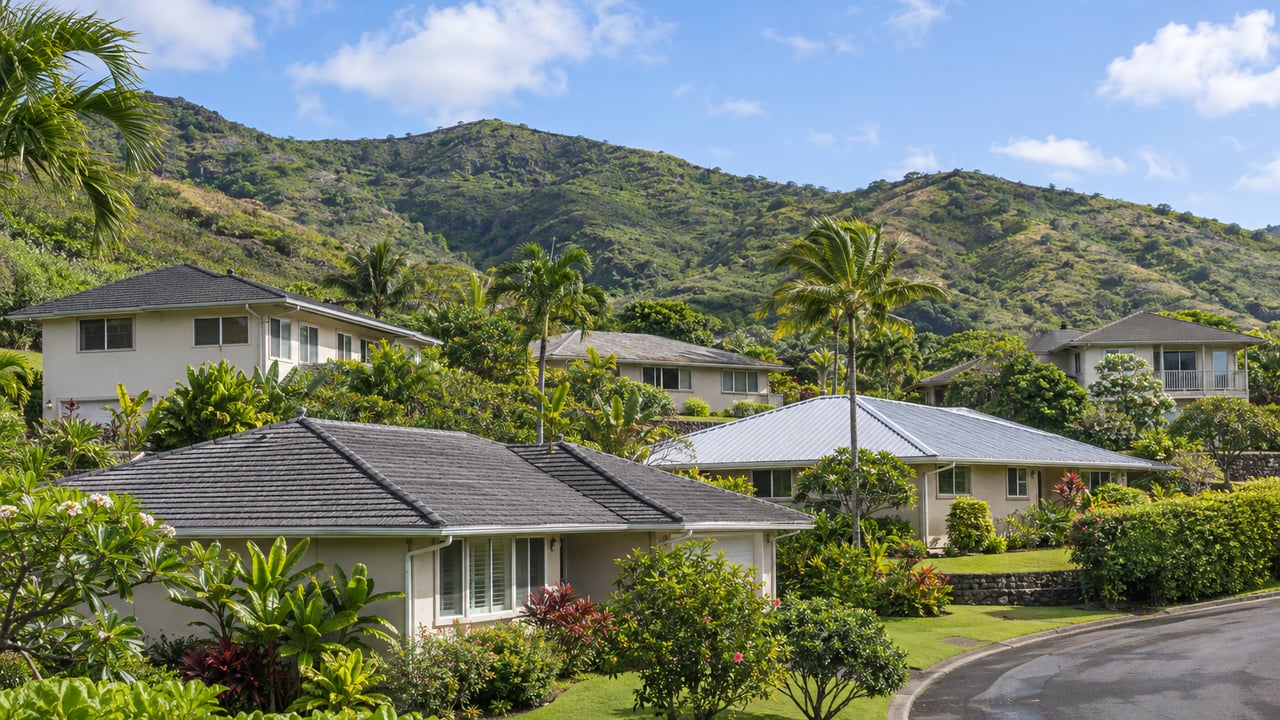
Hawaii Kai Home Prices, Read Street by Street
November 19, 2026
November 19, 2026
In September 2026, the median single-family home price in Hawaii Kai rose 32% from a year earlier, to $1,812,500, according to the Honolulu Board of REALTORS Oahu Local Market Update. Only eight houses closed in the Board's Hawaii Kai area that month, and none were in Kalama Valley, the subdivision with the most house sales so far this year. If you're comparing Hawaii Kai to other parts of East Honolulu, the area median is the least useful number on the page. The subdivision is the unit that holds its price.
The Board's Hawaii Kai area is tax map key zone 1-3-9, which runs from Portlock and the marina to Kalama Valley. In September 2026 its eight house sales were three in Koko Head Terrace, two in Mariners Cove, one in Mariners Ridge, one in Mariners Valley and one in Anchorage at $3,150,000. In September 2025 the nine sales included two Kalama Valley homes with a median of $1,232,000. Last year's September had two sales from the bottom tier. This year's had a marina-adjacent sale above $3 million and none from the bottom tier. That difference in mix explains most of the 32%.
Across the larger sample the change is much smaller. From January through September 2026, 104 Hawaii Kai houses sold at a median of $1,650,000. That is up 2.8% from $1,605,000 over the same nine months of 2025, with sales down 3.7%. Houses sold in a median of 13 days over those nine months, at 98.5% of original list price. In plain terms, demand held steady, prices changed little, and well-priced homes sold in about two weeks.
These are the Board's January–September 2026 single-family medians for the Hawaii Kai subdivisions with the most activity, using the MLS neighborhood names.
| Subdivision | Jan–Sep 2026 sales | Jan–Sep 2026 median | Jan–Sep 2025 median |
|---|---|---|---|
| Kamiloiki | 4 | $1,338,750 | $1,362,500 |
| Kalama Valley | 22 | $1,400,000 | $1,400,000 |
| Koko Head Terrace | 19 | $1,450,000 | $1,302,500 |
| Hahaione-Lower | 6 | $1,450,000 | $1,375,000 |
| Mariners Valley | 5 | $1,680,000 | $1,450,000 |
| Mariners Ridge | 10 | $1,940,000 | $1,875,000 |
| Triangle | 3 | $2,285,000 | $2,060,000 |
| Mariners Cove | 7 | $2,385,000 | $1,782,500 |
| Koko Kai | 5 | $2,650,000 | $3,725,000 |
| Anchorage | 3 | $2,990,000 | none reported |
| Portlock | 4 | $4,690,000 | $2,600,000 |
Kalama Valley and Koko Head Terrace together account for 41 of the area's 104 house sales this year, and both sit at roughly $1.4 million to $1.45 million. Kalama Valley's median was exactly $1,400,000 in both years, across 22 sales in 2026 and 19 in 2025. Of all the price signals in the table, that one has the most sales behind it and the most consistent reading.
The biggest swings in the table come from subdivisions with very few sales. Portlock's median rose 80% because it went from one sale to four. Koko Kai fell 29% on five sales. Queens Gate dropped from nine sales to two, and its median went from $2,084,000 to $1,705,000. At those counts, one larger lot or one dated interior can move the median by six figures. For pricing a specific home, recent sales on the same street or ridge are more reliable than any of these percentages.
The price gaps between tiers match how the area was built. The City's East Honolulu plan dates the master-planned Hawaiʻi Kai community to 1961. According to the plan, homes spread into the Kalama and Kamiloiki valleys and onto Mariners Ridge during the 1960s and 1970s, with ridges and valleys forming natural boundaries between neighborhoods. That shared building era helps explain why Kalama Valley, Kamiloiki, Koko Head Terrace and Hahaione-Lower all sell within about $110,000 of each other. Portlock is older. A University of Hawaiʻi Press history says Bishop Estate subdivided pasture at Koko Head in 1936 and named the subdivision for Captain Portlock. The East Honolulu plan describes Portlock Road's shoreline and treats the area as oceanfront. Queens Gate is different again. Its homeowners' association describes a gated community of 120 property owners surrounded by the Hawaiʻi Kai Golf Course.
The middle of the ladder, from Mariners Cove to Triangle to Anchorage, is where the marina comes in. According to the UH Press history, Bishop Estate leased 6,000 acres, including Ke-Ahupua-o-Maunalua, a traditional fishpond, to Kaiser Aetna. The State Historic Preservation Division's nomination for the Kaiser estate says Kaiser dredged Kuapā Pond and lined its banks with boulders, which created the Hawaii Kai Marina. Civil Beat has noted that development-era descriptions called the former pond a marsh, though it had been an important loko iʻa. Today Honolulu Magazine counts roughly 300 acres of waterways, with boats docked behind some of the homes, townhomes and condos along them. In Mariners Cove, Honolulu Magazine placed Niumalu Loop beside two mini-parks that border Kuapā Pond.
Part of the waterfront premium is direct boating access through a private marina. The Hawaii Kai Marina Community Association is the nonprofit that owns and manages the marina and its access to Maunalua Bay. Its posted 2026 annual dues are $600, due January 1, and the association says 2027 dues will be shared with members by early December. Its vessel registration schedule lists $20 a year for a marina waterfront resident and $575 a year for a Hawaii Kai resident who lives off the marina. If you're weighing a Mariners Ridge view home against a lower-priced home on the water, include these yearly costs in the comparison. They're general figures with dates, not legal or financial advice, so confirm your own situation with the association and the right professional.
Hawaii Kai's condo and townhome market moves on a different timeline from its house market. From January through September 2026, 106 condos and townhomes sold at a median of $788,000, down 4.7%. The median time on market was 48 days, 33% longer than a year earlier, and sellers received 96.2% of original list. On the house side, homes sold in 13 days at 98.5% of list.
As with houses, the condo median depends on the mix of sales, and one subdivision dominates it. West Marina accounted for 71 of the 106 condo sales through September, at a median of $865,000, down 8.2%, while the 27 Hahaione-Lower sales held nearly flat at $570,000 and six more in Mariners Valley came in at $785,000. September's 22% drop in the condo median, to $782,500, came from just ten sales, seven of them in West Marina and three in Hahaione-Lower. At the end of September, 73 condos and townhomes were listed for sale in the Hawaii Kai area, up from 68 a year earlier.
The islandwide numbers point the same way. In the Board's October 2026 release, Oʻahu condos took a median of 49 days to sell in October, up from 44 a year earlier, and condo inventory rose 7.0% to 2,506 listings. Single-family homes sold in 15 days, down from 26. Board president Aaron Tangonan said in that release that higher mortgage rates than a year ago "are putting additional pressure on buyers' budgets." In Hawaii Kai, the practical result is that condo buyers this fall usually have more time and more room to negotiate. House buyers in Koko Head Terrace or Kalama Valley usually don't.
Monthly Hawaii Kai figures will keep moving sharply as long as each month has only eight to twelve sales per property type. Before reading anything into a monthly change, check how many sales were in each subdivision that month. If Kalama Valley sales come back in a given month, the area median will probably fall even if no home lost value. One Portlock sale can push the median up just as fast. The Board publishes its islandwide monthly releases on its market reports page. Its September 2026 release reported an Oʻahu single-family median of $1,110,000 for that month. By the Board's numbers, every Hawaii Kai subdivision in the table above sold above that figure through September.
Is Hawaii Kai getting more expensive? Slightly, for houses. The nine-month median rose 2.8% to $1,650,000 through September 2026. Kalama Valley, the subdivision with the most house sales, held at $1,400,000 for the second year in a row.
Where does a Hawaii Kai house budget of about $1.5 million fit? Based on January–September 2026 medians, that budget matches Kalama Valley, Koko Head Terrace, Hahaione-Lower and Kamiloiki, the four subdivisions between $1.34 million and $1.45 million. Mariners Valley, at $1,680,000, is the next tier up.
Why do Hawaii Kai condos take longer to sell than houses? From January through September 2026, condos took a median of 48 days and houses took 13. The October islandwide numbers show the same split, and the Board ties some of the condo slowdown to mortgage rates.
For a deeper look at the housing types themselves, our post on single-family homes versus townhomes in Hawaii Kai covers them in more detail, and the Hawaii Kai neighborhood page has more on the area.
If you're working out which rung of the Hawaii Kai ladder fits your plans, or how your own Koko Head Terrace or Mariners Ridge home compares with recent sales on your street, Chelsey Flanagan would be glad to talk through the subdivision numbers with you. Let's Connect.
Stay up to date on the latest real estate trends.
From personalized search criteria, email updates for new or changed listings, community and school demographics, satellite map searches to free market reports, forms, and updated real estate news. Feel free to contact me and I will be happy to help you with all your real estate needs.